

Registration is a product, not a status. No federal ESA registry exists, so a number, card or vest proves nothing to a landlord and nothing to a business. What can be weighed is a dated letter from a professional who actually treats you. Since HUD's May 22, 2026 memo even that is no longer presumed to waive pet fees federally, though state and local law may still protect you.
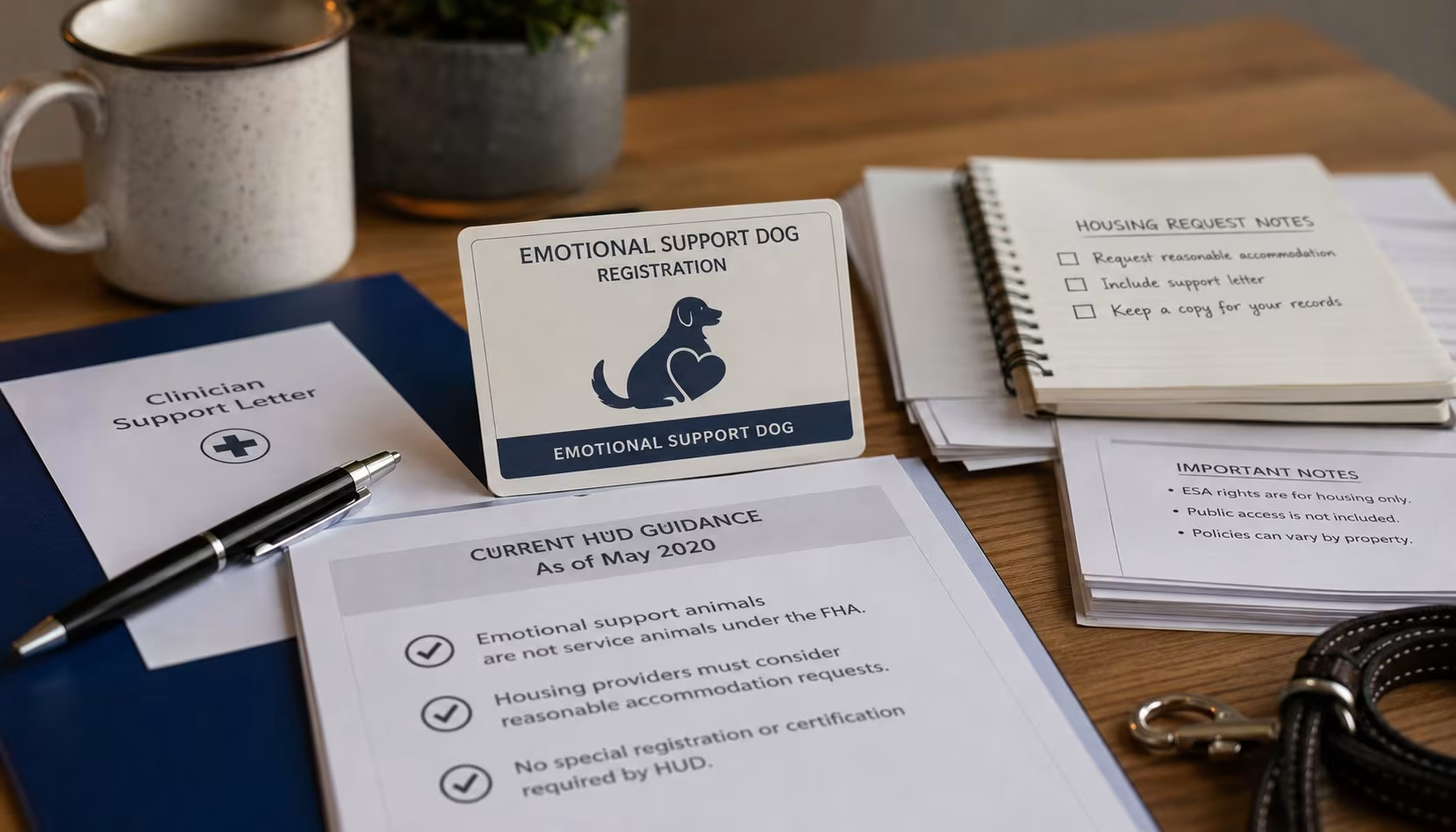
Emotional support dog registration sounds official, but it is often just a paid online listing. A website may sell a certificate, ID card, vest, tag, or registration number. Those items usually do not create legal rights, service dog status, housing approval, airline access, or public access.
If you need an emotional support dog for housing, the process is usually about disability-related need and appropriate documentation, not a registry.
What ADA rules actually require
The ADA's service animal requirements say a service animal is a dog trained to do work or perform tasks for a person with a disability. Emotional support alone does not make a dog a service animal under the ADA.
No online registration changes that. If your dog is not task-trained for disability-related work, do not represent the dog as a service animal.
Certification is the same product under a different name, and the ESA certification guide takes apart the sales language sites use for it. Registration, certification, ID card and registry number all describe the same transaction: a company takes payment and sends back a document it designed itself.

Registration gets you three things. A certificate or ID card, an appearance of officialdom in front of people who do not know the rules, and a folder to keep your own records in. None of the three obliges anyone to do anything, and the second one is a liability rather than an asset when a landlord or a business does know the rules.
Housing providers, airlines, schools, and workplaces can ask for their own process. A registry number may not matter.
An ESA letter is a different kind of object entirely. It comes from a licensed mental health professional who is treating you, it is dated, and it states that you have a disability-related need for the animal. Several states now set rules for how it is issued. California's AB 468, effective in 2022, requires a client relationship of at least 30 days before a letter can be written, subject to exceptions, and requires online ESA sellers to disclose that their letter is not a service animal certification.
HUD's May 22, 2026 animal accommodation enforcement guidance was effective immediately and is specific about what changed. HUD staff stop pursuing complaints where the animal is an untrained emotional support animal. Only individually trained service animals are presumed exempt from pet policies and pet fees. Open ESA cases were placed on hold for individual review.
State and local fair housing laws are not touched by that memo, and some still protect emotional support animals in housing. That is now the part of the picture worth checking first, because in many cases it is the only protection left standing.
| Online registration or certificate | ESA letter | Trained service dog | |
|---|---|---|---|
| Who issues it | A private company, on payment | A licensed mental health professional treating you | No document is required. The dog is trained to perform a task. |
| Recognized by federal law | No. There is no federal ESA registry. | Not as a status. It is evidence in an accommodation request. | Yes, under the ADA for public access. |
| Public access to shops, restaurants, hotels | None | None | Yes. Staff may ask only two questions: is the dog required because of a disability, and what task is it trained to perform. |
| Housing, federal position since May 22, 2026 | None | HUD staff no longer pursue complaints where the animal is an untrained ESA | Presumed exempt from pet policies and pet fees |
| Housing, state and local | None | Depends on your state. Those laws are unaffected by the HUD memo and some still protect ESAs. | Protected |
| Air travel | None | None. Airlines may treat ESAs as pets under the DOT rule effective January 11, 2021. | Trained service dogs must be accepted, with the DOT form. |
Read down the first column. Every cell in it is empty, and that is the entire argument of this guide.
Public access limits for ESAs
An emotional support dog does not have the same public access rights as a service dog under the ADA. Restaurants, stores, medical offices, hotels, rideshares, and public events may refuse ESAs where pets are not allowed.
Some places voluntarily allow dogs. That is a policy choice, not proof that registration worked.
For housing, ask the provider what reasonable accommodation process it uses. Provide truthful documentation when appropriate. Keep communication in writing. Do not send a registry card and assume the process is complete.
How much that process is worth depends heavily on where you live. Compare what applies in New York with what applies in South Carolina and the gap between two states on the same federal baseline is obvious.

Watch for instant approval, guaranteed landlord acceptance, lifetime certification, public access promises, or claims that no clinician relationship is needed. Be cautious if the site pushes a vest, badge, or card as the main proof.
Records that support responsible ESA ownership
Keep the clinician letter if you have one, veterinary records, vaccination records, local license where required, training notes, and behavior plans. These records do not turn the dog into a service animal, but they help show responsible care.
An emotional support dog should be under control, clean, safe, and manageable. Registration does not excuse biting, property damage, uncontrolled barking, or sanitation problems. Housing providers can respond to real safety or damage concerns.
Air travel is not a gray area. The Department of Transportation's Air Carrier Access Act final rule took effect on January 11, 2021 and lets airlines treat emotional support animals as pets. American, Delta, United, Southwest, JetBlue and Alaska all stopped accepting ESAs in early 2021. Only trained service dogs must be carried, and the airline may require the DOT Service Animal Air Transportation Form. Your dog travels as a pet in an under-seat carrier, usually for about $95 to $150 each way, or it travels not at all. Workplaces and schools run their own accommodation processes, and a registry number is not part of any of them.
Ask the specific airline, employer, or school before bringing the dog.
The dog should fit the person's needs and the dog's own welfare. A calm adult dog may be better than a high-energy puppy. A dog with severe separation anxiety or reactivity may add stress instead of support.
Which dog you pick does more work here than any document, and comforting dog breeds for ESA homes goes through what to look for in an adult dog you can actually live with.
Why registration creates false confidence
Registration feels tempting because it offers a quick answer to a stressful housing problem. It also gives owners something tangible: a card, number, certificate, or vest. The problem is that official-looking paperwork can create false confidence.
If the request is challenged, a registry may not answer the housing provider's real question: what is the disability-related need for this animal in this housing situation?
Start with the professional involved in your care. Ask whether an emotional support dog is appropriate. Then ask the housing provider for its accommodation process. Keep all communication dated and written. Prepare animal care records and behavior notes.
Do not use registration language to imply that your ESA is allowed in all public places. If someone asks whether the dog is a service animal, answer truthfully. An ESA may be deeply helpful at home and still not have public-access status.
Building a strong housing request
If your dog changes, your clinician changes, or you move, ask whether updated documentation is needed. A registration number from an old website does not explain current facts.
A useful ESA housing request explains the link between the disability-related need and the animal in that housing setting. It does not need to reveal every private medical detail, but it should be specific enough for the housing provider to evaluate the request under the rules that apply.
Strong documentation usually comes from a professional who has a real treatment relationship with the person. It should identify that an accommodation is being requested, describe why the animal helps with disability-related effects, and match the current living situation. A paid registry certificate usually does none of that.
Avoid saying that an emotional support dog is "registered as a service dog" or "certified for public access." Those phrases can create confusion and may cause a housing provider, business, or staff member to ask the wrong questions. Say what is true: the dog is an emotional support animal for housing, not a service dog trained to perform disability-related tasks in public.
Clear language protects the owner as much as anyone else. If a dispute happens later, accurate wording makes it easier to show what was requested and why.
Federal rules are now the weaker half of the picture. State legislatures have gone in two directions at once: some regulate who can write an ESA letter and how long they must have known the client, while others keep fair housing protections for assistance animals that HUD's own enforcement no longer pursues. Since May 2026 the second group is where an ESA housing request actually stands or falls, so find out which group your state is in before you spend anything.
Before paying any website, check the housing provider's process and look at state guidance from an official agency or a local legal aid resource. A registry site with polished marketing may not reflect current local requirements.
The request, in order
- Read your lease and the building's pet policy first. Note the weight limit, any breed list, the pet fee and the pet rent. Since the May 2026 HUD memo, an untrained ESA is not presumed exempt from any of these at the federal level, so you need to know what you are asking to be excused from.
- Find out whether your state or city fair housing law still protects assistance animals. Your local fair housing office or a legal aid line will answer this in one call, and the answer decides how strong your position is.
- Ask the housing provider, in writing, what its reasonable accommodation process is and whether it has a form. Use the form if there is one.
- Ask your treating professional for a letter that is dated, signed, on letterhead, carries a license number and state, and states a disability-related need for the animal. It should not name your diagnosis and should not call the animal a service animal.
- Submit the letter with the provider's form. Do not attach a registry card, certificate or ID. Sending one invites the provider to treat the whole request as a purchased product.
- Keep a dated copy of everything you send and everything you receive. If a decision comes by phone, follow up with an email summarizing what was said.
Responding to a housing denial
Ask for the reason in writing. Sometimes the issue is incomplete documentation, animal behavior, building rules, or a misunderstanding about the type of animal. A written reason gives you something concrete to address.
If the denial seems wrong, contact a fair housing organization, disability rights group, tenant hotline, or attorney in your area. Do not rely on a registry company to solve a housing dispute after it sells a certificate.
Housing conversations are not only about disability-related need. They may also involve whether the animal can live safely in the property. Keep ordinary pet records organized: vaccines, parasite prevention, license if required, emergency contact, training notes, and any complaint history.
If your dog has barking, guarding, house-soiling, or reactivity problems, address them early. A support animal still needs to be manageable around neighbors, staff, common areas, and maintenance visits. Good behavior records will not replace proper documentation, but they can reduce friction when a housing provider has practical concerns.
Many registration sites use urgent language: buy now, avoid denial, get instant approval, no questions asked. Be careful with any service that promises legal rights in minutes. Real accommodation requests depend on facts, housing rules, and current documentation, not a badge shipped in the mail.
| Reason given | What it usually means | What to do next |
|---|---|---|
| Documentation is insufficient | The letter is undated, unsigned, missing license details, or came from a site rather than a treating professional | Ask in writing exactly which element is missing, then go back to your own professional for a corrected letter |
| The animal exceeds the pet policy | Weight, breed or number of animals, and since May 2026 there is no federal presumption of exemption for an untrained ESA | Check whether state or local law still requires an exemption. If it does not, the negotiation is about the pet fee, not about rights |
| Behavior or damage complaints | Barking, soiling, or an incident on file | Address the behavior with a trainer and offer a written plan. No documentation overrides a genuine nuisance or safety record |
| The building is exempt | Owner-occupied buildings of four units or fewer, single-family homes rented without an agent, and some private club or religious housing sit outside the Fair Housing Act | Confirm the exemption applies. If it does, federal law has no answer here and local law is the only route |
| No reason given | Nothing to respond to yet | Request the reason in writing before doing anything else |
If the refusal looks wrong, a local fair housing organization or tenant hotline will assess it at no cost. The company that sold you a registration will not, and has no standing to.
Recap on ESA registration reality
Registration is not required anywhere, because there is nowhere to register. No federal agency keeps a list of emotional support animals, so every registry is a private database with an official-sounding name, and paying to be in one changes your legal position by nothing at all.
If you need an ESA for housing, focus on real disability-related need, appropriate professional documentation, current rules, responsible animal care, and honest communication with the housing provider.





0 Comments
No comments yet. Be the first to share your thoughts!
Leave a Comment