

Housing is still the strongest setting for an ESA dog, but it is weaker than it was. HUD withdrew its assistance-animal guidance in September 2025 and told staff in May 2026 to stop pursuing complaints about untrained ESAs, so fee waivers are no longer a safe assumption. State and city fair-housing law is unaffected, and that is now where most tenants should file.
An emotional support dog may be the reason a tenant sleeps, leaves the apartment, or keeps a daily care routine. That does not mean every building, landlord, airline, hotel, or public place must treat the dog the same way. Housing is the main setting where ESA dog questions come up, but the rules are more complicated in 2026 than many older articles suggest. A tenant needs accurate language, reliable documentation, and a dog who can live safely around neighbors.
Comfort dog versus trained service dog labels
An emotional support dog provides comfort through presence, routine, and companionship. A service dog is trained to do disability-related work or tasks. The ADA service animal FAQ says emotional support, therapy, comfort, and companion animals are not service animals under ADA public-access rules when they provide comfort just by being with a person.
That difference matters in housing communication. A tenant should not call an untrained ESA dog a service dog to gain stronger rights. Mislabeling can damage credibility, especially if the landlord asks what the dog is trained to do and the answer is only comfort.

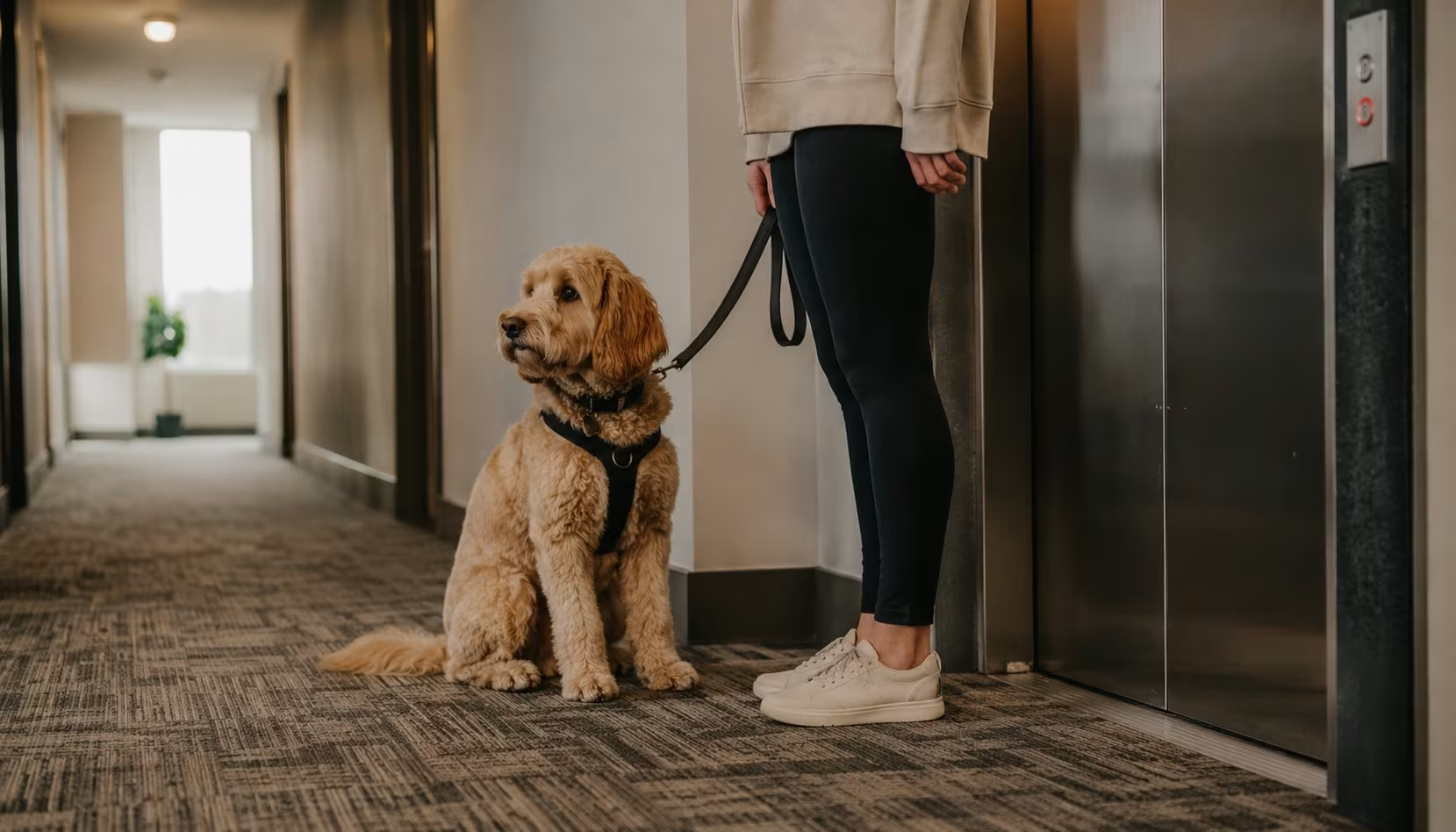
The dog still needs ordinary manners. Barking for hours, lunging in hallways, damaging doors, or soiling shared spaces can create real housing problems. ESA status is not a substitute for leash control, vaccination, parasite prevention, and a plan for maintenance visits.
Why blanket no-fee claims no longer hold
Older ESA housing articles often said that no-pet rules, pet rent, and pet limits simply do not apply to emotional support animals. That statement is too broad now. The Federal Register notice on withdrawal of HUD fair-housing guidance documents says several prior FHEO guidance documents, including animal-accommodation guidance, were withdrawn effective September 17, 2025 and should not be relied on as authoritative.
The bigger change came the following spring. On May 22, 2026 HUD's Office of Fair Housing and Equal Opportunity issued an enforcement memo, effective immediately, signed by Assistant Secretary Craig Trainor. It tells HUD staff to stop pursuing complaints where the animal is an untrained emotional support animal, to treat only individually trained service animals as presumptively exempt from pet policies and pet fees, and to place open ESA cases on hold for individual review. HUD said ESAs had been involved in more than 20 percent of its fair-housing complaints, which is why the agency treated this as a caseload problem as much as a legal one.
That memo binds HUD's own enforcement staff. It does not repeal the Fair Housing Act, and it does not touch state or local fair-housing law, which in many states protects assistance animals on its own terms. For a tenant in 2026 the practical consequence is a change of address: a complaint that would once have gone to HUD is now more likely to be worth filing with a state civil rights agency or a city human relations commission.
State law, local fair-housing rules, subsidized-housing programs, campus housing policies, private lawsuits, and court decisions can still affect the outcome. A tenant in California, Texas, New York, or South Carolina may face different paperwork and enforcement realities.
| Question | Common advice written before September 2025 | Federal position after the May 22, 2026 memo | Where a tenant may still have protection |
|---|---|---|---|
| Does a no-pet rule apply to my ESA dog? | No. An assistance animal is not a pet. | HUD staff will not pursue a complaint over an untrained ESA. Only individually trained service animals are presumed exempt. | State and local fair-housing law, which the memo does not change, and which in several states defines assistance animals more broadly. |
| Can the landlord charge pet rent or a pet deposit? | No, not for an assistance animal. | The exemption from pet policies and pet fees is presumed only for trained service animals. | State law and, where it applies, the terms of a subsidized housing program. |
| What happens to a complaint I already filed? | It proceeds through HUD's process. | Open ESA cases were placed on hold for individual review. | A parallel filing with a state or city civil rights agency, subject to that agency's own deadline. |
| Am I responsible for damage the dog causes? | Yes. | Yes. This did not change. | Not applicable. Damage liability is the same for every tenant. |
Building a credible accommodation request
A useful ESA housing request connects three things: the person has a disability-related limitation, the dog provides support connected to that limitation, and the requested accommodation is specific to the housing situation. The documentation usually comes from a licensed health-care or mental-health professional who has enough information to assess the person's need.
The letter should include the professional's identity, license information, date, and a plain explanation of the disability-related need without exposing a full medical history. It should not claim the dog is federally certified, ADA registered, or allowed everywhere. Online certificate language often makes a legitimate request look weaker.

The dog's medical file is separate from the tenant's disability documentation, but it still helps show responsible ownership. Keep vaccine records, local license papers, microchip information, parasite prevention, and training notes. If the dog has a health issue such as heartworm signs or an eye condition like entropion in dogs, handle that through the veterinarian rather than mixing it into the accommodation letter.
Writing a calm written request
Use a calm written request. Identify that you are asking for a disability-related housing accommodation involving your dog. Attach reliable documentation if the disability-related need is not obvious. Offer to follow reasonable rules for sanitation, control, vaccination, and emergency access. Ask for a written response and keep copies.
Do not start with threats or internet slogans. A landlord who sees "you cannot ask me anything" may become defensive, while a landlord who receives a clear request can identify what information is missing. If the housing provider asks for full therapy records or a diagnosis that feels invasive, pause and get advice from a fair-housing agency, legal aid office, disability-rights group, or attorney.
Timing helps. Make the request before moving in when possible, or before bringing the dog into a no-pet unit. A late request may still matter, but making it after fines, complaints, or lease notices can create extra friction. If the dog is already present, be honest about that and focus on resolving the documentation and management plan.
Behavior that strengthens or weakens a case
Pet fees are where the 2026 memo bites hardest. The old shorthand was that an approved assistance animal is not a pet, so pet rent, pet deposits and breed or weight limits do not apply to it. HUD staff now start from the opposite presumption for an untrained ESA, which means a landlord who charges pet rent on an ESA dog is far less likely to face a federal complaint over it. Whether that charge is lawful still depends on your state and city, so the useful question to a local fair-housing office is narrow: does state law here define an assistance animal more broadly than the current federal enforcement position. Damage is a separate question everywhere. An accommodation has never waived a tenant's responsibility for actual damage the dog causes.
Behavior is often the practical test. A quiet dog who walks on leash, uses a relief area, and rests during maintenance visits presents a different case from a dog who barks all day or rushes other tenants. If your dog struggles, start training before the issue becomes a complaint. Keep records of classes, private sessions, muzzle conditioning if needed, and veterinary behavior visits.
A dog who starts reacting in hallways after years of ignoring neighbors is usually telling you something medical. Pain, thyroid disease and failing sight all show up first as a shorter fuse, and an older dog whose eyes have gone cloudy with canine nuclear sclerosis may simply be startling more easily in a dim corridor. Get the veterinary exam before you accept a behavior label, and if anxiety medication comes up, understand what benzodiazepine use in dogs involves before starting it rather than after a complaint.
What landlords can reasonably expect
Housing providers can care about safety, property damage, sanitation, noise, and whether the requested accommodation creates an undue burden or major change in housing operations. They can also care whether documentation is reliable. A landlord is not required to accept every purchased card or vague online form as proof of a disability-related need.
Pick up waste, control barking, prevent fleas, keep the dog leashed in shared areas, and have a plan for repairs. If the dog is alone during work hours, use cameras, walkers, daycare, enrichment toys, or training help as needed. Preventable complaints weaken the request even when the human need is real.
Roommates add another layer. Allergies, fear, shared leases, and household damage can complicate the request. Student housing and shared rentals may have policies that require an interactive process. Get the decision in writing and ask how disputes will be handled.
Before any of this matters, check whether the Fair Housing Act reaches your building at all. The Act has never covered every rental in the country, and the exemptions predate the 2026 memo entirely.
- An owner-occupied building with four or fewer units, sometimes called the Mrs. Murphy exemption.
- A single-family house rented out by its owner without using a real estate agent or broker.
- Certain private clubs and religious organizations renting to their own members.
If your unit falls into one of these, the landlord's pet policy is largely the whole answer under federal law, and the accommodation request is a negotiation rather than a right. Your state or city may still cover the building, and many do, which is another reason to check local law first rather than last. It is worth confirming before you spend money on a clinician letter for a two-unit house where the owner lives downstairs.
Getting help when a denial happens
Get local help if the landlord denies the request, demands unusual records, charges fees you believe are improper, threatens eviction, or says the dog must leave immediately. Also seek help if the dog has a bite history, serious complaints, or property damage. A fair-housing agency or lawyer can tell you what current federal, state, and local standards apply.
Do not rely on an ESA registry website to solve a housing conflict. Those sites may sell fast paperwork, but they do not represent you, defend you in court, or know the details of your lease. The useful path is slower but stronger: real clinical documentation, accurate language, responsible dog care, and local advice before the dispute escalates.
- Ask for the denial in writing and ask one follow-up question: what information would change the answer. A provider who will not put a reason in writing has given you your first useful piece of evidence.
- Check whether your state or city has its own fair-housing or human rights agency. After the May 2026 memo this is usually the more productive filing, and its deadline is often shorter than the federal one.
- Contact a local legal aid office or a tenant union before the response deadline in any lease notice, not after. Free housing counseling exists in most metro areas and is faster to reach than a private attorney.
- If eviction has been filed, treat that as the emergency and get counsel on the eviction first. The accommodation argument becomes a defense inside that case rather than a separate track.
Organizing a clean supporting file
A strong file is not a giant folder of private medical records. It is a clean set of documents that answer predictable questions. Keep the clinician letter, lease, written accommodation request, landlord replies, vaccination records, local license, proof of parasite prevention, training notes, and any incident reports or complaint resolutions. Save emails as PDFs or screenshots with dates.
Keep the tone consistent. If you say the dog is needed for routine and symptom support, the rest of the file should show a dog who can live predictably in the unit. If there was a barking complaint, include what changed: a walker, crate training, white noise, vet visit, or behavior plan. A record of correction is better than pretending the complaint never happened.
If the provider asks for more information, respond to the actual request. Do not send unrelated medical articles, dog-health pages, or emotional statements that expose more private detail than needed. Ask what specific information is missing and whether a revised professional letter would address it.
If a fee is the issue, separate the categories before answering. Pet rent, damage charges, cleaning bills, deposits, and fines are not always treated the same way. Ask the housing provider to identify the exact charge and the policy behind it.
Two things decide most of these cases before a lawyer is ever involved. The first is whether the letter comes from someone who actually treats you and says so plainly. The second is whether the dog has a complaint history in the building. A tenant with a thin letter and a quiet dog usually gets a workable outcome. A tenant with a perfect letter and three noise complaints usually does not, and after May 2026 there is less federal backstop when that goes wrong.





0 Comments
No comments yet. Be the first to share your thoughts!
Leave a Comment