

Housing, and increasingly not much else. An emotional support cat can support a reasonable accommodation request under fair-housing law, but HUD's May 2026 enforcement memo means untrained ESAs no longer get federal backing, so state and city law now carries the request. Cats are not ADA service animals and not DOT service animals, so public places and airlines owe them nothing.
A cat can be the animal that keeps a disabled tenant functioning at home: the feeding routine gets them out of bed, the cat's weight on their lap helps them settle after panic symptoms, and the daily care pattern reduces isolation. That does not mean the cat can enter every restaurant, airplane cabin, office, or grocery store as a matter of federal law. Emotional support cats have their strongest legal footing in housing accommodation requests. Outside housing, the rights are narrower, more fact-specific, and often depend on a business policy or a separate accommodation process.
Shifting federal rules on housing accommodation
Housing is still where emotional support cat questions land, and the ground moved twice in under a year. HUD withdrew its 2013 and 2020 assistance-animal guidance on September 17, 2025. On May 22, 2026 the Office of Fair Housing and Equal Opportunity issued an enforcement memo, effective immediately, signed by Assistant Secretary Craig Trainor, telling staff to stop pursuing complaints where the animal is an untrained emotional support animal, to presume only individually trained service animals exempt from pet policies and pet fees, and to hold open ESA cases for individual review. HUD said ESAs had been involved in more than 20 percent of its fair-housing complaints.
Read carefully, the memo is about what HUD's own staff will pursue. It does not amend the Fair Housing Act and it does not reach state or local fair-housing law, which in many places protects assistance animals on its own terms and in some places defines them more broadly than the federal enforcement position now does. The practical effect for a cat owner is a change of venue rather than the end of the right. A complaint that would have gone to HUD in 2024 is now more likely to be worth filing with a state civil rights agency or a city human relations commission.
The memo itself is short and worth reading before you rely on anything written about it, including this page. HUD published it as enforcement guidance on assessing requests for the use of an animal as a reasonable accommodation. Whatever it says about federal enforcement, the three questions that decide an individual request have not changed: whether you have a disability-related need, whether the cat is connected to that need, and which law reaches your particular building.
The word registration is the problem. It suggests a government list a cat can be added to, and no such list exists at any level. What people are actually buying is a certificate, a vest or a private database entry, none of which a landlord has to accept. The document that carries weight is a letter from a licensed professional who treats you, and the registration guide for emotional support cats covers how to tell one source from the other.

Documentation a landlord may request
If the disability and need for the cat are not obvious, a housing provider may request reliable information that supports the accommodation. That usually means documentation from a licensed professional such as a physician, psychiatrist, psychologist, therapist, social worker, or other provider allowed under state law. The document should connect the person, the disability-related limitation, and the cat's support without exposing unnecessary private medical details.
A landlord generally should not demand the tenant's full diagnosis, complete therapy records, or proof that the cat has special training. ESAs are not service animals, and housing law does not usually require task training for an assistance animal. What matters is the support the cat provides in the home and the reason the person needs that support.
Timing matters. It is cleaner to request the accommodation before a lease violation notice, pet fine, or conflict with neighbors. Keep all communication in writing, keep copies of documents, and ask the housing provider to identify any missing information instead of trading tense phone calls.
Why public access does not extend to cats
The Americans with Disabilities Act draws a sharp line between service animals and emotional support animals in public places. The ADA service animal rules define service animals as dogs trained to do work or perform tasks directly related to a person's disability. Dogs whose only function is comfort or emotional support do not qualify under that ADA service-animal definition, and cats are not included as ADA service animals.
That means an emotional support cat generally does not have a federal right to enter restaurants, grocery stores, theaters, hotels, medical waiting rooms, rideshares, or retail shops the way a trained service dog may. A business can choose to allow a cat if health codes and policy permit it, but that is permission, not an automatic ESA right. A carrier, leash, or vest does not change the ADA category.
Workplaces are separate from public customer spaces. An employee may request a disability accommodation through an employer's process, but the answer depends on the job, workplace risks, documentation, alternatives, and state law. For a work dispute, talk with HR, a disability-rights advocate, or an employment lawyer rather than relying on an ESA card.
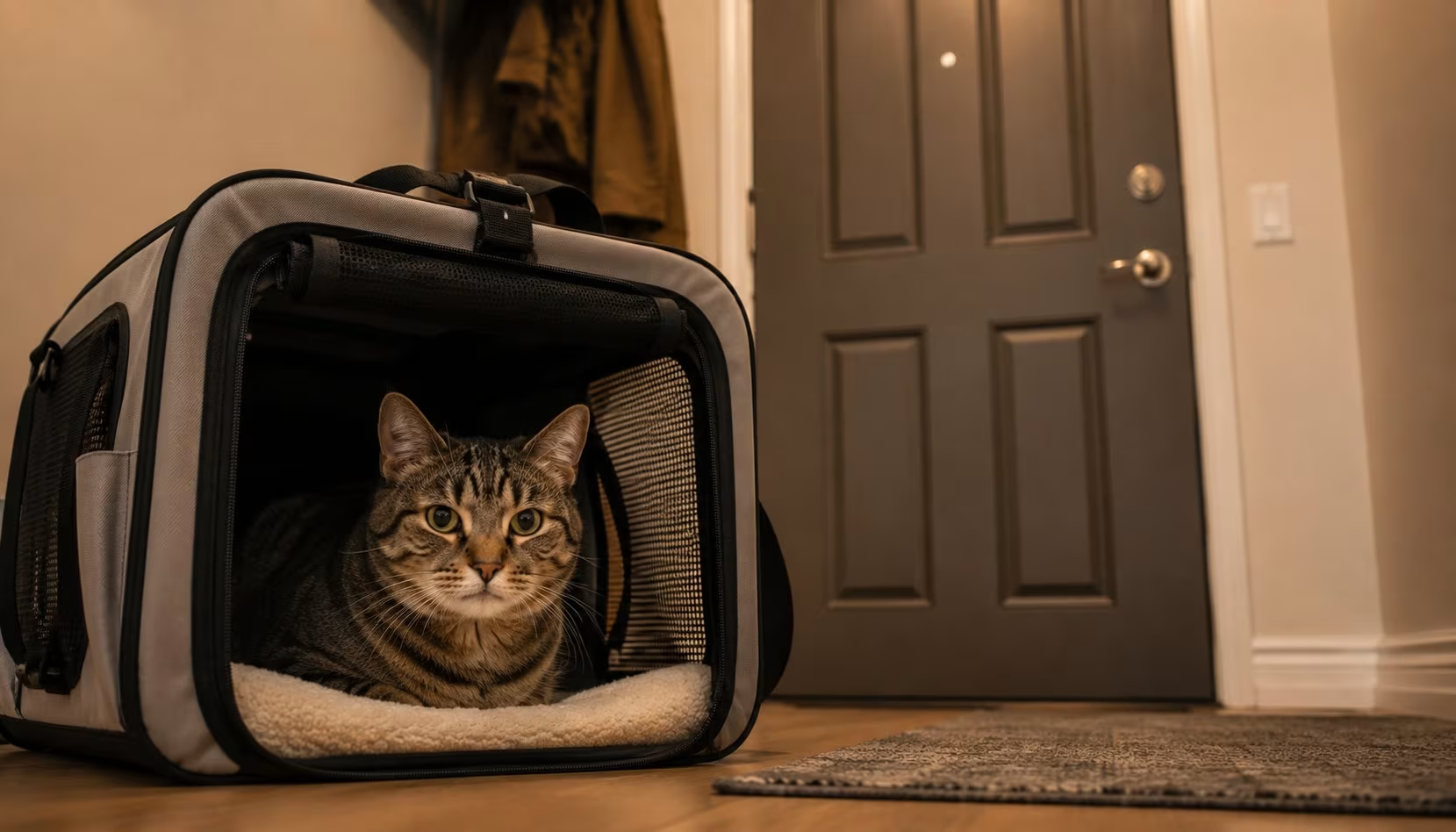
The workplace runs on a different statute and it is the one setting where an ESA cat still has a live argument. Public access falls under ADA Titles II and III, where the service-animal definition controls and a cat is simply out. Employment falls under ADA Title I, which is not about service animals at all. It requires a covered employer to engage in an interactive process over a reasonable accommodation for a known disability, and the accommodation can be anything that works, including an animal, unless it imposes an undue hardship.
What that means practically:
- You are not asserting a right of access. You are opening a negotiation, and the employer is required to participate in it rather than simply say no.
- The request goes to HR or a designated accommodation coordinator, in writing, not to a manager in a corridor.
- The employer can ask for documentation of the disability and the need, can propose alternatives, and can refuse an animal where the workplace makes it genuinely unworkable, such as a sterile or food-production area.
- Coworker allergy or fear is a real factor and is usually handled by separating spaces rather than by refusing outright.
- State disability law may be broader than the ADA and applies to smaller employers in some states.
None of this depends on an ESA letter formatted for a landlord. What an employer wants is documentation aimed at job function: what the disability limits, and how the animal's presence addresses it during the working day.
Airline policy changes for support animals
Airline rules changed in a way that affects ESA cats directly. The U.S. Department of Transportation's service animal air-travel guidance says service animals under the Air Carrier Access Act are dogs trained to do work or perform tasks for a qualified person with a disability. Emotional support animals and species other than dogs are not treated as service animals under that federal air-travel rule.
In practice, an emotional support cat usually travels as a pet if the airline accepts cats in cabin or cargo for that route. The airline may charge pet fees, require a carrier under the seat, limit the number of pets, restrict international travel, or refuse travel when temperature or destination rules create safety problems. A mental health letter does not force an airline to treat the cat as a service animal.
Plan early. Call the airline before booking, check the destination country's animal-entry rules, and ask your veterinarian about health certificates, microchips, vaccines, and stress management. Sedation is not a casual choice for air travel; discuss risks with a vet, especially for senior cats or cats with heart or breathing issues.
| Item | Where it stands |
|---|---|
| When the rule changed | DOT published its Air Carrier Access Act final rule in December 2020. It took effect on January 11, 2021. |
| Which animals must be accepted | Only dogs individually trained to do work or perform tasks, using the DOT Service Animal Air Transportation Form. No cat qualifies under any circumstances. |
| Which US airlines still accept ESAs | None of the major carriers. American, Delta, United, Southwest, JetBlue and Alaska all ended ESA acceptance during early 2021. |
| What a cat costs in the cabin | Roughly $95 to $150 each way as a pet, plus the carrier. |
| Carrier requirement | Closed, ventilated, and sized to fit under the seat in front of you. Dimensions are set by the airline operating the aircraft, which on a codeshare is not always the one that sold the ticket. |
| Any exceptions left | Some foreign carriers, including some Latin American and European airlines, still accept ESAs under their own policies. That is an airline policy, not a right, and destination import rules still apply. |
Behavior problems that can void protection
ESA rights do not excuse unsafe or destructive behavior. A housing provider may have grounds to deny or later challenge an accommodation if the cat presents a direct threat, causes substantial property damage, creates severe sanitation problems, or repeatedly disrupts other residents. A single manageable behavior issue is different from an ongoing pattern that the owner refuses to address.
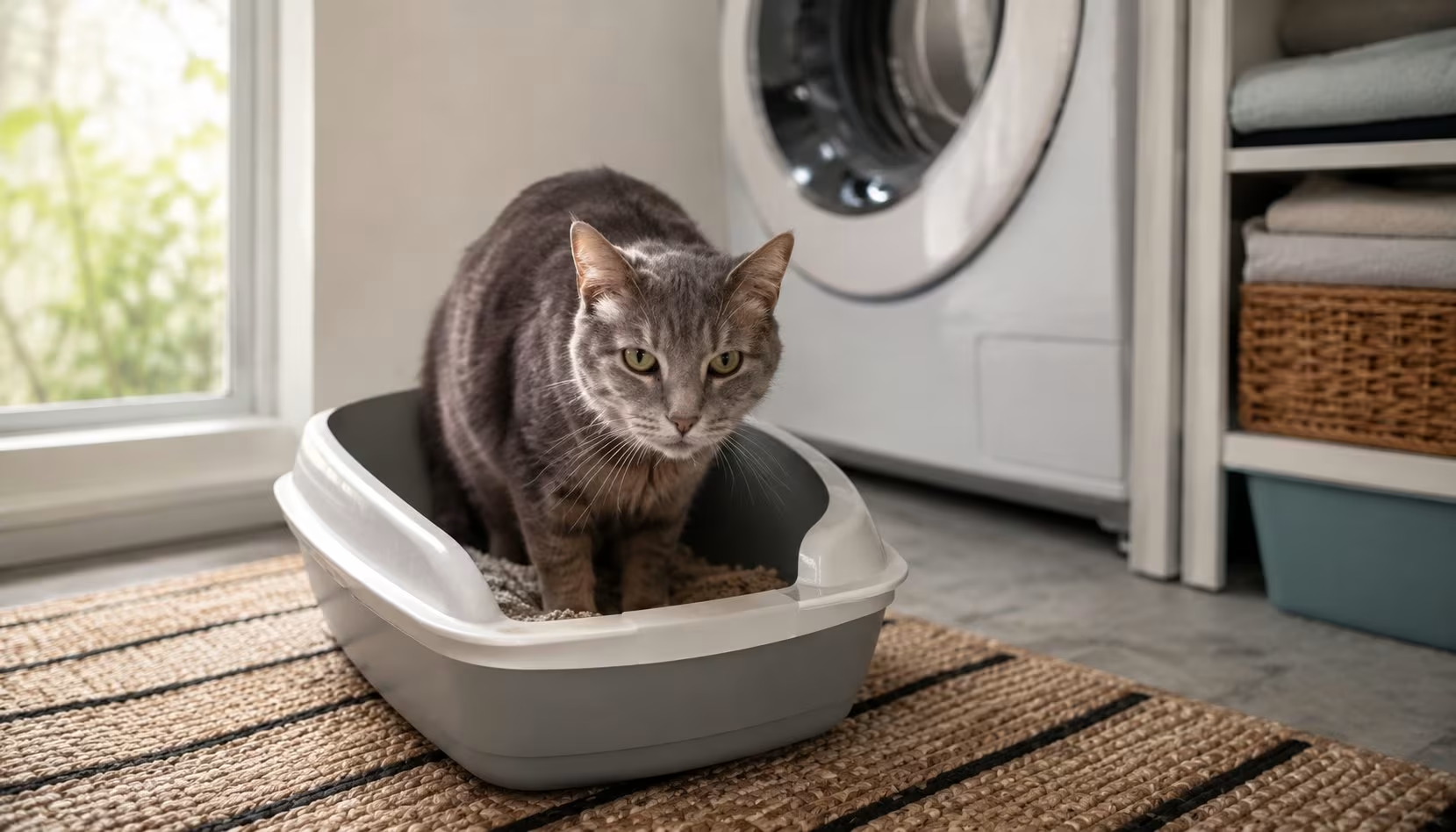
For cats, the most common housing problems are urine outside the box, scratching door frames, flea infestation, loud nighttime vocalization, and escape into shared areas. A clean litter setup is not just courtesy. It protects the accommodation. PawDraft's litter box training guide can help with box count, placement, substrate, and cleaning routines before a complaint forms.
A behavior complaint is often a medical problem with a deadline attached. Urinating outside the box can be a urinary blockage, which in a male cat is an emergency measured in hours, not a housekeeping failure. A cat that stops eating needs a vet within a day or two, since even short fasts put cats at risk of liver complications, and the causes behind why a cat is not eating are worth knowing before you assume stress. Night vocalizing in an older cat frequently traces to thyroid disease, pain or cognitive decline, all covered under senior cat health. Getting the exam early protects the cat and gives you something specific to tell a landlord who has already received a complaint.
Records that prove responsible ownership
Pet fees are the part that changed, and this is where older articles are now actively misleading. The long-standing shorthand was that an approved assistance animal is not a pet, so pet rent and pet deposits do not apply to it. HUD's May 2026 enforcement memo reversed the starting presumption: only individually trained service animals are presumed exempt from pet policies and pet fees, and a cat cannot be one. That does not automatically make a pet fee on an ESA cat lawful, because state and local fair-housing law is untouched by the memo and several states are more protective. It does mean a tenant should expect the charge, ask which law the landlord is relying on, and check their own state before assuming a waiver. Damage was never part of this argument. If the cat shreds carpet, scratches trim or leaves urine damage, the tenant can be charged for it on the same terms as anyone else.
Photograph the unit the day you move in, before the cat is in it. Scuffed trim and stained carpet that were already there become your problem at move-out otherwise, and this is the single cheapest piece of evidence a tenant can create. Alongside those photos keep vaccination records, parasite prevention, microchip details, vet invoices, and a note of your litter routine. One practical warning for winter: space heaters and improvised bedding cause more landlord disputes and more vet visits than cold does, so read up on keeping cats warm in winter before adding anything that plugs in.
A short accommodation letter to the landlord should be calm and specific: identify the request, attach reliable documentation if needed, state that the cat is an assistance animal related to a disability, and offer to discuss reasonable rules for sanitation, control, and emergency access. Do not oversell the cat as certified, licensed, or federally registered. That language often makes a legitimate request look weaker.
If the cat has a history of urine marking, scratching, escape attempts, or loud nighttime vocalization, address that before the request becomes a fight. A behavior plan, veterinary check, added litter boxes, nail care, and door-control routine show practical responsibility. The legal argument is easier to hear when the housing provider is not also dealing with preventable complaints in shared hallways downstairs.
Order matters more than volume. A tenant who does these five things in sequence rarely ends up in the dispute the rest of this article describes.
- Before the cat arrives. Photograph the unit. Read the lease clause on pets and note whether it mentions assistance animals separately.
- Before the request. Get the letter from a clinician who treats you. Confirm the litter and scratching setup is adequate, because the request is easier to grant when nothing has gone wrong yet.
- The request itself. One page in writing. What you are asking for, that the cat is an assistance animal related to a disability, the letter attached if the need is not obvious, and an offer to discuss sanitation and access for maintenance.
- After any reply. Save it dated. If the provider asks for more, answer that specific question and nothing beyond it. Do not volunteer records nobody requested.
- If a complaint arrives. Respond with what you changed, not with a denial. Added boxes, a vet visit, nail trimming, a behavior plan. A documented correction is stronger evidence than an unblemished record you cannot prove.
Getting local legal guidance when disputes arise
Federal rules set the main framework, but state laws, local fair-housing agencies, subsidized housing rules, campus housing policies, and court decisions can affect the details. A landlord's refusal may be unlawful, but a tenant's paperwork may also be incomplete. Both problems are easier to fix before eviction threats, fines, or move-out deadlines.
If the request is denied, ask for the reason in writing and ask what information would change it. A refusal that will not be put in writing is itself worth having on record. Then take it to a state or city fair-housing agency, a legal aid housing clinic, or a tenant union, in that order, because after May 2026 the federal route is the least likely of the three to move. Do that before any deadline in a lease notice runs, not after. The window to fix a documentation gap is usually wide open right up until the moment somebody files an eviction, and then it closes.




0 Comments
No comments yet. Be the first to share your thoughts!
Leave a Comment