

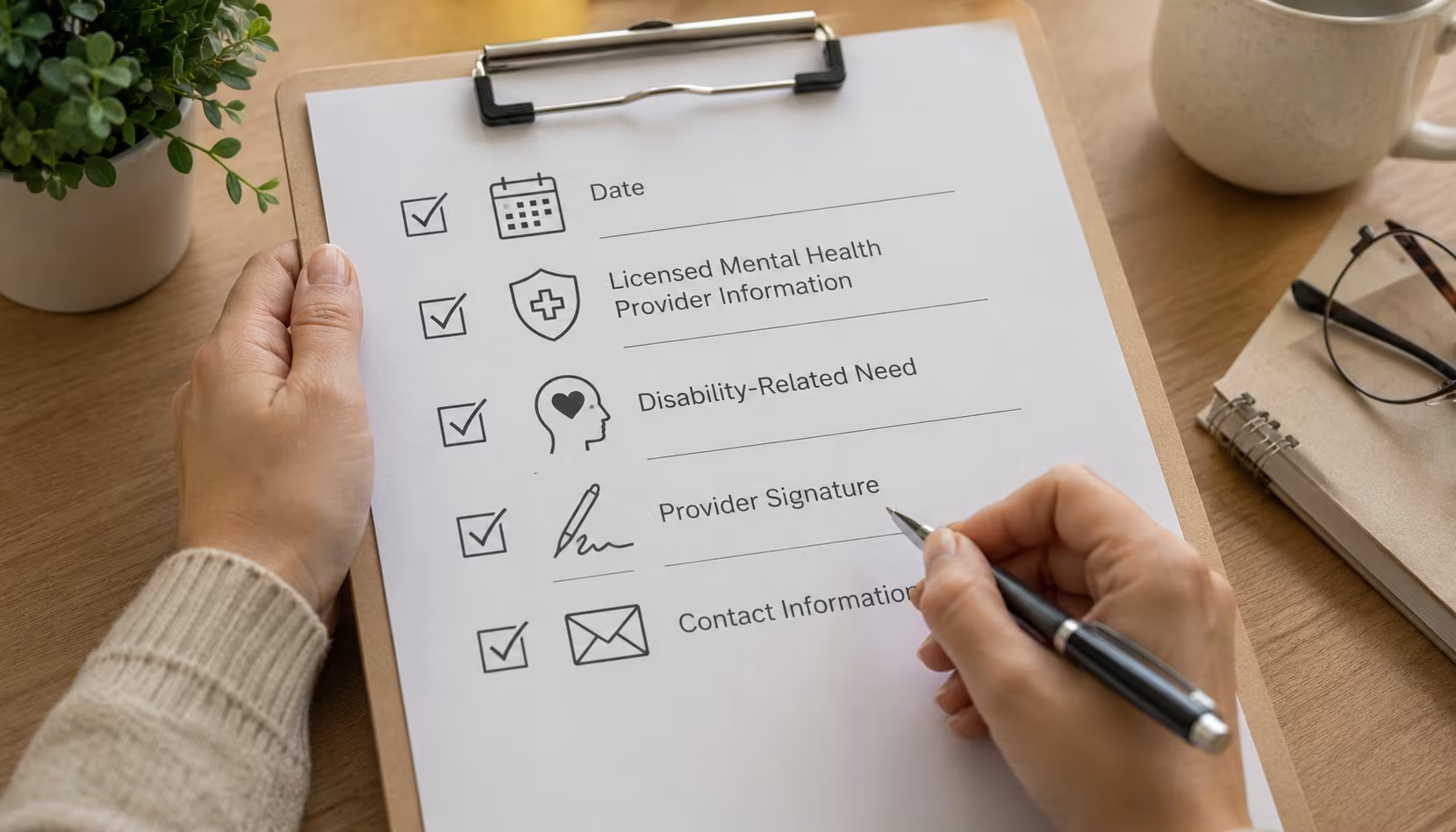
A valid letter comes from a licensed professional who has actually assessed you. It sits on letterhead and carries their license type, number, jurisdiction, the date and a signature, and it states that you have a disability-related need for the animal. It should claim nothing about airlines or public access, since it has no effect in either. Registration products add nothing.
An emotional support animal letter is not a magic pass. A useful ESA letter is documentation from a qualified professional explaining that a person has a disability-related need for an assistance animal in housing. It should be accurate, current, and connected to a real clinical relationship.
Online registries, ID cards, vests, and certificates are often marketed as if they create legal rights. They do not replace a proper letter. Housing providers are allowed to evaluate whether the request is supported by reliable information when the disability-related need is not obvious.
Who can write a valid letter
The letter comes from a licensed mental health professional acting within their scope: a psychologist, psychiatrist, licensed therapist or counselor, or a licensed clinical social worker. A physician or nurse practitioner who treats you may qualify, and this is the part that varies most by state, so check before you assume your primary care provider can write it. The license has to be live in the state where you live, not merely somewhere.
The relationship behind the letter is what a landlord is really testing. A clinician who has seen you a handful of times can write one. A website that collected twelve multiple-choice answers and a card payment cannot, and California has written that into law: AB 468 has required a 30-day client relationship before a letter is issued since 2022, with limited exceptions, and requires online ESA sellers to state in writing that what they sell is not a service animal certification.

If the vocabulary is still slippery, assistance animal against service animal against ESA, our page of simple questions about ESA sorts the terms out before you take them into a leasing office, where using the wrong one costs you.
The letter should connect the animal to the person's disability-related need. It does not need to reveal every private detail, but it should support why the animal is part of the accommodation request.
For example, the animal may help reduce symptoms, support routine, provide grounding, reduce isolation, or help the person function in housing. The wording should be truthful and specific enough to be useful.
HUD's January 2020 assistance animal notice is the document most landlords learned this from, and it warned against treating purchased certificates and registrations as proof. HUD withdrew it, along with its 2013 guidance, on September 17, 2025, and on May 22, 2026 told its enforcement staff to stop pursuing complaints involving untrained emotional support animals. Read it for context, not as current federal guidance, and do not cite it to a housing provider as if it were.
- Start with the clinician you already see. A treating provider is the strongest source, and the request is a normal one: you need documentation for a housing accommodation.
- Ask two questions in the appointment. Are you willing to write it, and what would you need to see before you did? Some will decline on policy, and it is better to hear that months before a lease renewal.
- Bring specifics, not adjectives. Nights slept through with the animal present against nights without. Episodes and how long they lasted. What you manage to do on the days the routine holds.
- If you have no current provider, find one licensed in your state and expect to be assessed. In California a letter cannot be issued until a 30-day client relationship exists, and other states are moving the same way.
- Check the finished letter before you send it. Letterhead, license type, number, jurisdiction, date, signature, one sentence on disability-related need, and nothing at all about airlines or public access.
- Keep the original as a PDF and send that. A photograph of a printout invites a verification call you could have avoided.
What the letter should and should not claim
The ADA's service animal requirements state that emotional support, comfort, or companionship alone does not make an animal a service animal. A service animal must be trained to do work or tasks related to a disability.
A strong ESA letter usually includes the professional's name, license type, license number, jurisdiction, contact information, date, a statement that the person has a disability-related need for the animal, and the professional's signature. It should be on letterhead when possible.
It should promise nothing about airplanes, restaurants or hotels, because a letter that does is either written by someone who does not know the law or by someone selling to people who do not. Airlines have treated ESAs as pets since the Department of Transportation's rule took effect on January 11, 2021. Restaurants and shops were never covered. Hotels treat an ESA as a pet unless they choose otherwise, at roughly $25 to $75 a night.
The letter should not claim that registration makes the animal legal. It should not copy generic language without evaluation. It should not diagnose more than needed. It should not say the animal is a trained service animal unless that is true.
Registry language is the fastest way to have a letter dismissed, because there is no federal ESA registry for anyone to be registered with. A letter that leads with a registration number tells a landlord where it was bought. We take those sites apart in registering an emotional support animal, facts versus scams.
Letters go stale in practice even though no statute sets an expiry. Most housing providers want one dated within the past year, and lease renewals and changes of property management are the two moments that reliably trigger a request for a current one. Ask the clinician who wrote it for a refresh rather than editing the date yourself, which turns a valid document into a forged one.
| Element | Present and correct | Why a landlord cares |
|---|---|---|
| Letterhead and practice details | Clinician's or practice's own letterhead, with a working phone number | It is what they call to verify. A number that rings nowhere ends the request. |
| License type, number, jurisdiction | All three, and the state matches where you live | They can check it against a state board lookup in under a minute. |
| Statement of disability-related need | You have a condition that limits a major life activity and the animal helps with its effects | This is the only sentence that legally matters. |
| The animal | Species, and usually a name | The accommodation attaches to one animal, so a new animal needs a new letter. |
| Date and signature | Both, and dated within the past year | No statute sets an expiry, but a stale letter invites a request for a current one. |
| Your diagnosis | Not required | They are not entitled to it, and including it gives away privacy you cannot get back. |
| Registration or certificate number | Should not appear | No federal ESA registry exists. Its presence signals a purchased document. |
| Claims about flights or public access | Should not appear | False on their face, and they discredit the parts of the letter that are true. |
Spotting a legitimate telehealth evaluation
Telehealth can be legitimate if the provider is licensed, evaluates the person, follows state rules, and can provide follow-up. Telehealth becomes suspicious when a website guarantees approval, sells instant letters, or never creates a real provider-patient relationship.
An ESA letter supports the person's need; it does not excuse dangerous behavior. The animal should be manageable, house-trained, safe in shared spaces, and appropriate for the housing setting. Noise, damage, bites, and sanitation issues can still create problems.
Species is worth settling before the letter is written, since a letter naming a specific animal does not travel to a different one. Our comparison of the best emotional support animals weighs care demands against what a small apartment can absorb.
The strongest letters describe a limitation rather than a feeling. Not that the animal is comforting, but that the person sleeps through the night with the animal in the room and wakes four times without it, or leaves the building with the dog and does not otherwise. That is what a clinician can put their license behind, and we look at how it plays out for people who struggle with fear of human presence.
Telehealth is not the dividing line people assume. A video assessment by a clinician licensed in your state, who keeps notes and offers follow-up, produces an ordinary clinical document. What fails is the model with no assessment in it at all, and the tells are consistent: approval promised before anyone speaks to you, a price that includes a vest or an ID card, no named clinician, no license number, no state, and a support address instead of a practice phone number.
One test settles most of it. Ask, before paying, whether the clinician will respond to a verification call from a housing provider. A treating professional will say yes without hesitation, because verifying that a letter is genuine does not require disclosing anything about your treatment. A seller will deflect, and that answer is worth more than any badge on the checkout page.
Distinguishing affection from disability-related need
Affection is not the standard, and a letter that reads like a tribute to a beloved animal is the kind that gets set aside. The bond is real, and we write about it in ESA animals as a friend, but the document a landlord reviews has to say what the animal does about a limitation, not what the animal means to you.
Submit the request in writing. Attach the letter if documentation is needed. Ask for written confirmation. Keep copies. Be polite and factual. If the provider asks for something unclear, ask what specific information is needed.

A housing provider may ask for reliable documentation when the need is not obvious. They may not demand your therapy notes, your diagnosis or your full medical history, and a request for those is worth pushing back on in writing. If the letter is rejected, ask for the reason in writing, then take that reason to the clinician if it concerns the document, or to your state or city fair housing agency if it concerns the refusal. Since May 2026, HUD staff have not been pursuing untrained ESA complaints, so the state agency is the live route. Buying a second letter from a faster website fixes nothing.
State law is now the main event rather than a footnote. The May 2026 HUD memo left every state and local fair housing statute intact, so in states with their own assistance animal protections the accommodation still works, enforced by a state agency. Several states also regulate the letter itself. California requires a 30-day client relationship and a written disclosure from online sellers. Others set no waiting period at all. Ask your clinician what applies where you live before you pay anyone.
Before paying for a letter, ask whether it meets the rules for your state and housing situation.
Verifying the letter without full records
A housing provider may contact the professional to verify that the letter is real, but that does not mean they get full medical records. The professional should be reachable through the contact information on the letter and should know what they wrote.
Fake phone numbers, unverifiable clinics, and template letters can create delays or denials.
The request should use clear housing language. For example, the tenant is requesting a reasonable accommodation to keep an assistance animal because of a disability-related need. The letter supports that need. It does not need to argue that the animal is a pet exemption or luxury.
If more than one person in a household relies on the animal, documentation should explain the relevant need. If one tenant has the need and another owns the animal, the housing provider may ask practical questions about control, responsibility, and care.
Naming the animal and using accurate terms
The letter may or may not identify the animal by name, species, breed, or size depending on the situation. Housing providers often need to know which animal is being requested so they can evaluate practical issues.
Do not swap animals under the same old letter without checking whether updated documentation is needed.
If the animal is a dog, the letter still should not claim the dog is an ADA service dog unless the dog is task-trained for that role. A phrase like "emotional support dog" can be accurate for housing while still being different from "service dog."
Be cautious if a provider promises approval before speaking with you, refuses to list a license, cannot say where they are licensed, or sells accessories as part of the legal proof. A legitimate clinician should be able to explain their role and limits.
If the letter feels like a receipt, it may not hold up.
The fee question changed in May 2026. Federal enforcement no longer presumes that an untrained emotional support animal is exempt from pet policies or pet fees; only individually trained service animals get that presumption. Where state or local law still treats an ESA as an assistance animal, the exemption holds under that law. Damage was never covered either way, and a handler remains responsible for the actual cost of what the animal destroys.
Ask the housing provider to explain any fee in writing if an accommodation is approved but pet fees remain.
Keeping organized documentation over time
Keep one folder: the letter, the request email, the provider's written response, vaccination records and any local animal license. Property managers change, and the person who approved the arrangement is often gone by the time it is questioned. A verbal approval from a manager who has left is worth nothing, so get the approval itself in writing at the time.
If the animal dies, is rehomed, becomes unsafe, or no longer provides the same support, the old letter may not fit the new situation. Discuss changes with the clinician before submitting paperwork for a different animal.
An ESA letter supports a housing request; it does not replace the animal's normal care. Keep vaccines, parasite prevention, grooming, training, and emergency plans current. A well-cared-for animal is easier to accommodate and safer for neighbors.
Summing up what makes a letter valid
The test is simple enough to apply to a letter you already hold. Can you name the licensed person who assessed you, and would they take a verification call about what they wrote? If yes, the letter is real, and where state law still backs assistance animals it does real work. If no, what you own is a receipt, and every landlord who has seen a few of them knows the difference on sight.




0 Comments
No comments yet. Be the first to share your thoughts!
Leave a Comment