

There is no registry to join. No federal or state body registers emotional support cats, so a certificate, ID card or listing number buys nothing a landlord has to respect. The only document with weight is a letter from a licensed mental-health professional who treats you, and since HUD's May 2026 enforcement memo even that carries less federal protection than it did.
Emotional support cat registration is one of the most misunderstood topics in pet ownership. Many websites sell certificates, ID cards, badges, or registry listings. Those items may look official, but they usually do not create housing rights by themselves. What matters is whether a person has a disability-related need for the animal and whether the documentation is reliable under the rule that applies to the situation.
An emotional support cat can be deeply helpful. A cat can provide routine, companionship, touch, sleep cues, and a calmer home environment. The legal side, though, is not created by a decorative certificate. A clean, honest documentation plan protects the person, the landlord relationship, and the cat.
Why cats cannot be ADA service animals
An emotional support cat is a companion animal that helps reduce disability-related symptoms through presence and routine. The cat is not a service animal under the ADA because service animals in that context are dogs trained to do specific work or actions for a person with a disability.
The ADA's service animal FAQ makes that public-access distinction clear. Emotional support, comfort, and companionship by themselves do not give a cat restaurant, grocery store, workplace, or hotel access under the ADA.
PawDraft's guide to the legal rights for emotional support cats explains why housing, travel, and public places should be treated as separate questions.

There is no official federal emotional support cat registry that turns a pet cat into an ESA. Paying for a listing number, vest, tag, or certificate does not prove disability-related need. A landlord, airline, school, or business may reject registry-only paperwork.
PawDraft's article on how to register an emotional support animal goes deeper into the difference between a paid listing and usable documentation.If you are considering paying an online service, these five checks separate a clinician from a certificate mill. Run them before you enter a card number.
- Find the clinician's name and license number before you pay. A legitimate service names the professional and their license type. A mill assigns one after payment, or never names one.
- Verify the license yourself. Every state licensing board publishes a searchable register of therapists, psychologists, social workers and physicians. The license must be current and must be valid in the state where you live, not where the website is based.
- Ask how long the relationship has to be. California's AB 468 has required a client relationship of at least 30 days before an ESA letter is issued since 2022, with limited exceptions. A service offering same-day approval to a California resident is describing something that does not meet that state's rule.
- Look for the required disclosure. AB 468 also requires online ESA sellers to state plainly that the product is not a service-animal certification. A site selling into California without that disclosure is telling you how carefully it reads the law.
- Ask what happens next. A real clinician can answer a landlord's follow-up question, write an amended letter if information is missing, and be reached in six months. A certificate cannot do any of those things, and follow-up is where most disputes are actually resolved.
What a housing letter must include
For housing, documentation usually needs to come from a licensed professional who can evaluate the person's disability-related need for the animal. The letter often includes the professional's name, license type, license jurisdiction, contact information, date, and a statement connecting the animal to the disability-related need. It should not need to reveal the person's full diagnosis in detail.
The balance to aim for is a letter specific enough that a housing provider can tell a real clinician wrote it, and restrained enough that it does not hand over your diagnosis history. The full breakdown of ESA letter requirements covers the elements in order.
Keep veterinary records separate from the ESA letter. Vaccine records, spay or neuter status, flea prevention, and behavior notes help show responsible ownership, but they do not replace disability documentation.
Housing is where ESA cat documentation is most often used. The Fair Housing Act has historically required housing providers to consider reasonable accommodation requests for assistance animals, including emotional support animals, when the request is supported and reasonable.
That changed in two steps. HUD withdrew its 2013 and 2020 assistance-animal guidance on September 17, 2025. Then on May 22, 2026 its Office of Fair Housing and Equal Opportunity issued an enforcement memo, effective immediately, instructing staff to stop pursuing complaints where the animal is an untrained emotional support animal, to presume only individually trained service animals are exempt from pet policies and pet fees, and to hold open ESA cases for individual review. Its assistance animal guidance page is where any further federal change will appear.
For a cat owner this matters more than it does for a dog owner. A dog can in principle be trained to perform a task and cross into service-animal status. A cat cannot, under any federal definition. So an ESA cat now falls entirely outside the only category HUD staff will presume exempt from pet rules. What the memo does not touch is state and local fair-housing law, and several states define assistance animals more broadly than the current federal enforcement position. Check your state's civil rights agency before you conclude the answer is no.
If the landlord refuses, ask for the refusal in writing and ask what information would change it. That single question converts a vague no into either a fixable gap or evidence. From there the useful contacts are a tenant union, a legal aid housing clinic, or your state civil rights agency, and the wider picture on housing rights for emotional support animals is worth reading before you make that call.

Make the request before conflict if possible. Use calm wording. Say you are requesting a reasonable accommodation for an assistance animal. Attach the clinician letter if the disability-related need is not obvious. Offer basic animal information: species, name, approximate age, weight if relevant, and vaccination status.
If the landlord asks for more information, answer the request that is allowed and relevant. A landlord generally should not demand a full diagnosis or unrelated medical records, but the exact dispute can depend on law and facts.
| Include | Why it helps | Leave out | Why it hurts |
|---|---|---|---|
| The professional's name, license type, license number and issuing state | It is the only part a housing provider can independently verify | A registry or certificate number | No registry exists, so quoting one signals the letter came from a product rather than a clinician |
| A statement that the writer has a treatment relationship with you, and roughly how long | Goes to whether the assessment is real. In California a relationship of at least 30 days is required by statute. | Your diagnosis, medication list or session history | More private detail than the request needs, and it cannot be withdrawn once sent |
| That you have a disability-related need and the cat supports it in the home | This is the accommodation request in one sentence | Any claim that the cat is certified, registered or ADA approved | None of those exist for cats, and the claim makes a genuine request look bought |
| The date, on the professional's letterhead | Providers routinely discount undated letters and letters more than a year old | A promise of access to stores, flights, hotels or workplaces | Outside housing an ESA letter has no legal effect, and overreach invites the provider to distrust the whole document |
| Contact details for follow-up questions | Lets a provider resolve a gap by asking rather than denying | A demand that the landlord must comply | Turns a request into a confrontation before the interactive process has started |
Flying with a cat under airline rules
Air travel changed for ESAs. The U.S. Department of Transportation's service animal final rule allows airlines to treat emotional support animals as pets rather than service animals. Since cats are not DOT service animals, an emotional support cat usually travels under the airline's pet policy if the airline allows cabin pets.
That means fees, carrier size, reservation limits, destination rules, and health certificates may apply. PawDraft's article on taking emotional support cats on flights covers travel planning. The short version is that an ESA letter does not guarantee free cabin access for a cat.
An emotional support cat does not automatically have access to restaurants, stores, hospitals, offices, schools, or hotels. Some places may choose to allow pets. Some workplaces may consider accommodation requests under employment law, but that is not the same as open public access.
Three terms get used interchangeably and only one of them carries access rights. A therapy animal visits other people in a hospital, school or care home, under a program that screened it, and has no rights outside the visit it was invited to. An emotional support animal supports its own owner and is not trained to do anything. A service animal is individually trained to perform a task for its handler's disability, must be a dog under the ADA, and is the only one of the three that a store, restaurant or hotel has to admit.
Behavior problems documentation cannot fix
Good documentation cannot fix unsafe or disruptive animal behavior. A landlord may have concerns if a cat is destructive, aggressive, repeatedly escapes, creates sanitation problems, or damages property. Preventive care matters.
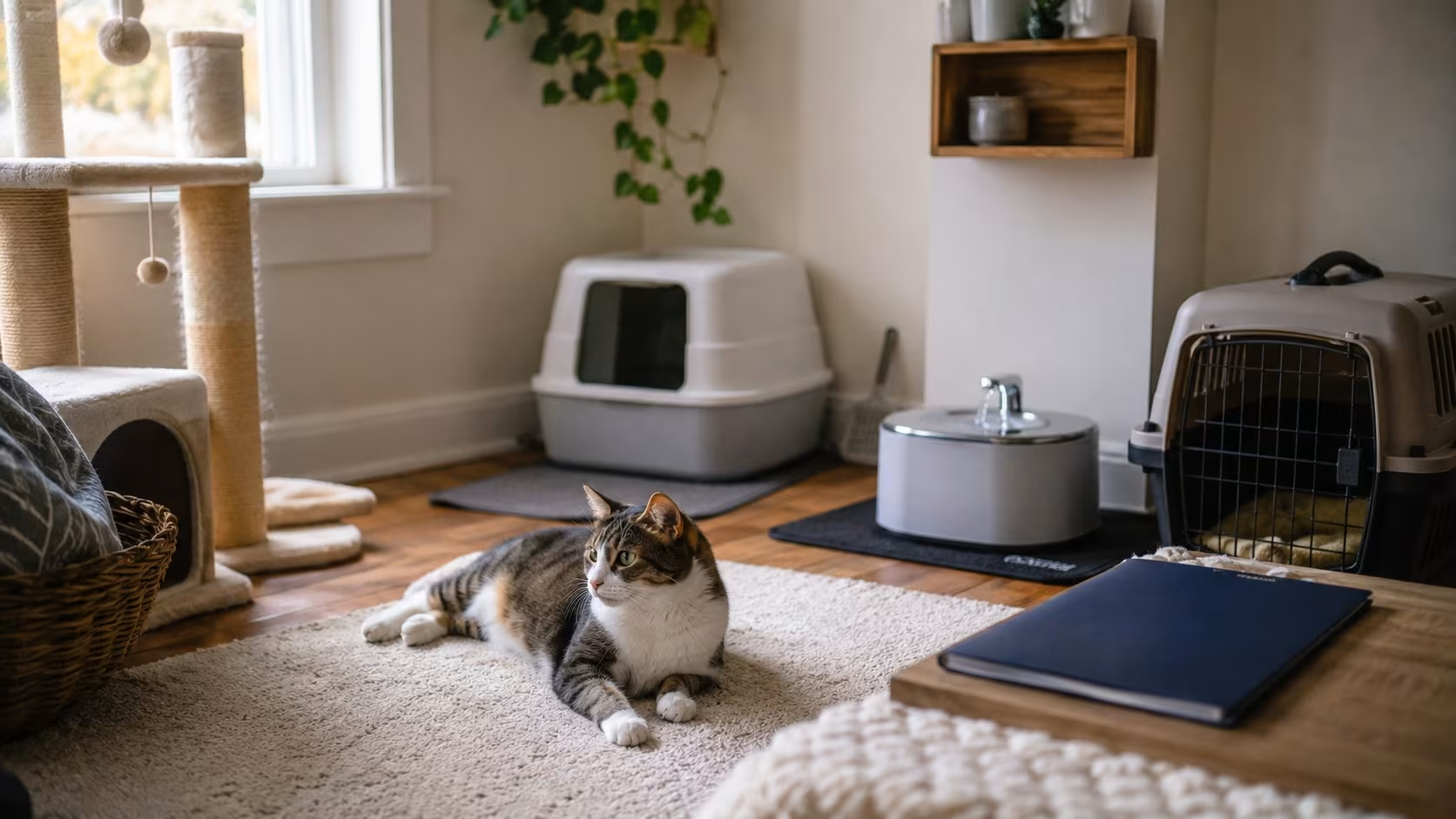
Set up enough litter boxes, scratching surfaces, hiding spots, enrichment, and routine. Keep nails trimmed. Use carriers for transport. Keep vaccines and parasite prevention current. If the cat is spraying, biting, hiding constantly, or fighting with other pets, talk to a veterinarian or qualified behavior professional.
Temperament decides more than paperwork does. A cat that hides from every visitor and sprays when the routine changes will generate complaints no letter can absorb, which is part of the wider question of whether cats are effective at emotional support in the first place.
Be careful with any service that sells instant approval, lifetime certification, federal registration, guaranteed landlord acceptance, or a letter without a real evaluation. Also be careful if the site encourages you to mislabel your cat as a service animal.
A legitimate clinician should be licensed, should evaluate your need, and should be reachable through normal professional channels. Some states have telehealth rules or waiting periods for ESA letters. Check your state before paying for an online service.
Ask what you are actually buying. If the product is a decorative certificate, a tag, or a private listing, it may have no legal value. If the product is a clinician evaluation, ask who performs it, where the clinician is licensed, whether follow-up is available, and whether the letter follows your state rules.
Do not buy a rush letter after a landlord has already challenged the request unless you understand the risk. Poor documentation can make a reasonable request look careless. A slower, properly reviewed letter is usually better than a fast certificate with broad promises.
Two numbers do more for a housing request than any paperwork. The first is the litter box count: one box per cat plus one spare, kept in separate locations rather than lined up in the same corner, since a single box in a shared bathroom is the most common cause of the urine complaints that end accommodations. The second is scratching surfaces: at least one tall enough for the cat to stretch fully upright, placed where the cat already scratches rather than where it looks tidy, because a post in an unused spare room does not compete with the door frame by the sofa.
Get both right before the request goes in, not after the first complaint. A landlord evaluating an accommodation for a cat is weighing one thing above all others: whether this animal will damage the unit or generate calls from neighbors. A tenant who can describe their setup in two specific sentences is answering that question before it is asked.
Organizing records for multi-cat households
Keep the ESA letter, lease messages, veterinary records, vaccine history, microchip information, flea prevention, and behavior notes in one folder. If the cat has never damaged the apartment, note that. If the cat uses the litter box reliably, keep the setup stable. If the landlord has a pet addendum, store that separately from the accommodation request so fees, deposits, and disability accommodation questions do not get mixed together.
For multi-cat homes, be clear about which cat is the emotional support animal and why. A second cat may be allowed as a pet by policy, but that is different from a disability-related accommodation request. If more than one support animal is requested, the documentation should explain the need for each animal.
An ESA request should still make sense as the cat ages. A kitten may become a loud adult. A calm adult may develop kidney disease, arthritis, or litter-box trouble later. Revisit the care plan each year. The cat's health, the tenant's symptoms, the housing setup, and the backup caregiver list can all change. Keeping the plan current makes the accommodation easier to defend and kinder for the cat.
Starting with real need, not a registry
The honest version of this guide is short. Nothing registers a cat, so the money spent on a certificate is gone. Find a licensed professional who will actually see you, get a letter that names their license and jurisdiction, make the housing request in writing before there is a conflict, and keep the cat's litter and scratching situation good enough that no neighbor has a reason to complain. That combination of reliable documentation and a quiet cat is worth more than any product sold under the word registration.

0 Comments
No comments yet. Be the first to share your thoughts!
Leave a Comment