

There is no federal certificate for an emotional support dog. What counts is a letter from a licensed mental health professional who actually treats you, written for a specific setting, usually housing. Online registries, vests and ID cards carry no legal weight. Since HUD's May 2026 enforcement memo, federal housing protection for untrained ESAs is much weaker, though state law may still apply.
A person with depression may feel safer leaving the bedroom because a dog needs breakfast at 7 a.m. A person with panic symptoms may sleep better because a familiar dog rests against the bed. That can be real support, but it does not create a federal certificate, public-access pass, or automatic travel right. The formalities for an emotional support dog are mostly about honest documentation and the setting where the request is being made. Housing, public places, flights, and workplaces do not follow one simple rule.
Comfort dogs versus trained service dogs
An emotional support dog provides comfort through presence, routine, and companionship. A service dog is individually trained to perform disability-related work or tasks. The ADA service animal FAQ makes that distinction directly: emotional support, therapy, comfort, and companion animals are not service animals under ADA public-access rules when their only function is comfort.
That category choice is the first formality because the wrong label leads to bad paperwork. If the dog naturally calms someone but has no trained task, the request is about emotional support. If the dog is trained to interrupt self-harm, guide a disoriented handler to an exit, retrieve medication, or perform another disability-related task, the conversation may involve a psychiatric service dog.

Pet-health records are not evidence about the person. A write-up of why dogs lick their paws constantly documents the dog's allergies or skin, and a housing provider reviewing an accommodation request will not read it as anything else. The only document that carries weight in that file is one signed by a professional licensed to assess the human side, on letterhead, with a license number and jurisdiction.
What makes a letter credible
A useful emotional support dog letter comes from a licensed health-care or mental-health professional who has enough information to assess the person's disability-related need. The letter should identify the professional, license type, license jurisdiction, date, and the general connection between the person's disability-related limitation and the animal's support. It should not need to reveal every private diagnosis, therapy note, medication, or trauma history.
The best letters are plain and specific. They avoid grand claims such as "certified for all public access" or "federally registered ESA." They state that the person has a disability-related need for the animal in a particular context, usually housing. A letter that looks purchased after a two-minute online form may be challenged because it does not show a meaningful clinical relationship.
If the clinician does not know the dog, they can still address the person's need for an assistance animal, but they should not certify behavior they have never observed. The owner remains responsible for house-training, noise, safety, vaccination, and damage. A dog who bites neighbors, destroys doors, or eliminates in hallways can create problems even when the human need is real.
| Element | Credible version | Version that gets challenged |
|---|---|---|
| Who signed it | Named licensed mental-health or health-care professional, license type and number, state of licensure | "Licensed professional" with no name, or a signature block belonging to a website rather than a practice |
| Relationship | The professional treats or has assessed the person. California requires a 30-day client relationship before a letter is issued, with limited exceptions | Letter issued minutes after an online questionnaire, from a clinician licensed in a state the tenant has never lived in |
| What it states | The person has a disability-related need for an assistance animal, and the animal helps with that limitation | Full diagnosis, medication list and therapy notes, which the provider is not entitled to and should not receive |
| Scope | Written for a housing accommodation request | "Certified for all public access" or "federally registered ESA", claims no letter can make |
| Date | Current, dated, and refreshed if the tenancy or the treatment relationship has changed | Undated, or years old with no ongoing relationship behind it |
Why online registries carry no legal weight
There is no federal emotional support dog registry that creates legal rights. A vest, tag, laminated card, certificate number, or online database may look official, but those items do not replace a disability-related accommodation process. Some sellers use government-sounding names and urgent language, then sell paperwork that landlords, employers, and airlines may reject.
A person may pay for a certificate, bring the dog to a restaurant, and then be surprised when staff say no. Under ADA public-access rules, a dog that only provides emotional comfort is not a service animal. A business may allow the dog voluntarily if policy and health rules allow it, but federal ADA access is not guaranteed by an ESA letter.
Air travel has its own rule. The U.S. Department of Transportation's service animal air-travel page says that under the Air Carrier Access Act, a service animal is a dog trained to do work or perform tasks for a qualified person with a disability. Emotional support animals are not treated as service animals under that rule, so an ESA dog usually travels under the airline's pet policy if allowed.

| Setting | What governs it | What the letter does |
|---|---|---|
| Rental housing | Fair Housing Act plus state and local fair-housing law. HUD's May 2026 enforcement memo tells federal staff to stop pursuing complaints based on untrained ESAs | Still the one setting where a letter is worth having, but the practical route now runs through state agencies rather than HUD |
| Stores and restaurants | ADA. Only dogs, and in limited cases miniature horses, individually trained to do work or perform tasks count as service animals | Nothing. Access is at the business's discretion. Staff may ask only whether the dog is required because of a disability and what task it is trained to perform |
| Hotels | ADA plus the property's own pet policy | Nothing by right. The dog is a pet, which at pet-friendly properties usually means roughly $25 to $75 per night or a flat $50 to $150 per stay |
| US flights | DOT's Air Carrier Access Act rule, effective January 11, 2021, which lets airlines treat ESAs as pets | Nothing. Major US airlines ended ESA acceptance in early 2021. The dog flies as a pet in cabin, typically about $95 to $150 each way, subject to under-seat carrier limits |
Federal housing guidance shifting in 2025
Housing has historically been the strongest setting for emotional support animal requests, but the federal enforcement landscape has changed. The Federal Register notice on withdrawal of HUD FHEO guidance documents states that several guidance documents, including prior animal-accommodation guidance, were withdrawn effective September 17, 2025 and should not be relied upon as authoritative. On May 22, 2026 HUD's Office of Fair Housing and Equal Opportunity issued an enforcement memo, effective immediately, telling staff to stop pursuing complaints in which the animal is an untrained emotional support animal and to place open ESA cases on hold for individual review. Only individually trained service animals are presumed exempt from pet policies and pet fees.
The memo changes enforcement, not the statute. The Fair Housing Act still exists and private lawsuits are still possible, but the federal agency that used to take these complaints has stepped back from untrained emotional support animals. State and local fair-housing laws are untouched by the memo and in many states still protect ESAs, which makes a state fair-housing agency the more useful place to file. The Fair Housing Act also never covered every rental. Owner-occupied buildings with four or fewer units, single-family homes rented without an agent, and some private club and religious housing sit outside it, and that has been true since long before 2026. A tenant facing a denial, a pet fee, or an eviction threat should start with a state agency or a legal aid office.
The practical formalities are still useful: make the request in writing, explain that the dog is connected to a disability-related need, attach reliable documentation if needed, and keep records of vaccination, licensing, behavior, and communication. Ask the housing provider to identify any missing information. Do not threaten legal action in the first email unless a professional has advised that tone.
Describing functional need instead of affection
A clinician can write a clearer letter when the person can describe the functional problem and the way the dog helps. "My dog makes me happy" is not the same as "My symptoms make it difficult to maintain a morning routine, and caring for this dog helps me get out of bed, leave the unit, and interrupt isolation." The second statement connects the animal to a disability-related limitation without turning the dog into a miracle cure.
Keep the dog's side of the file clean. Save vaccine records, local license information, microchip details, parasite prevention, training notes, and incident-free rental history if available. If the dog has a behavior problem, address it before the request becomes a dispute. A landlord is more likely to take the request seriously when the dog is clean, controlled, and not creating preventable complaints.
Veterinary problems belong in the same folder, because an untreated dog is the one that generates complaints from neighbors. Contagious skin conditions are the usual trigger in shared buildings, so deal with sarcoptic mange in dogs or grain mites in dogs before a manager sees the dog scratching in the lobby, and treat why a dog is vomiting blood as an emergency room question rather than something to mention in an accommodation request.
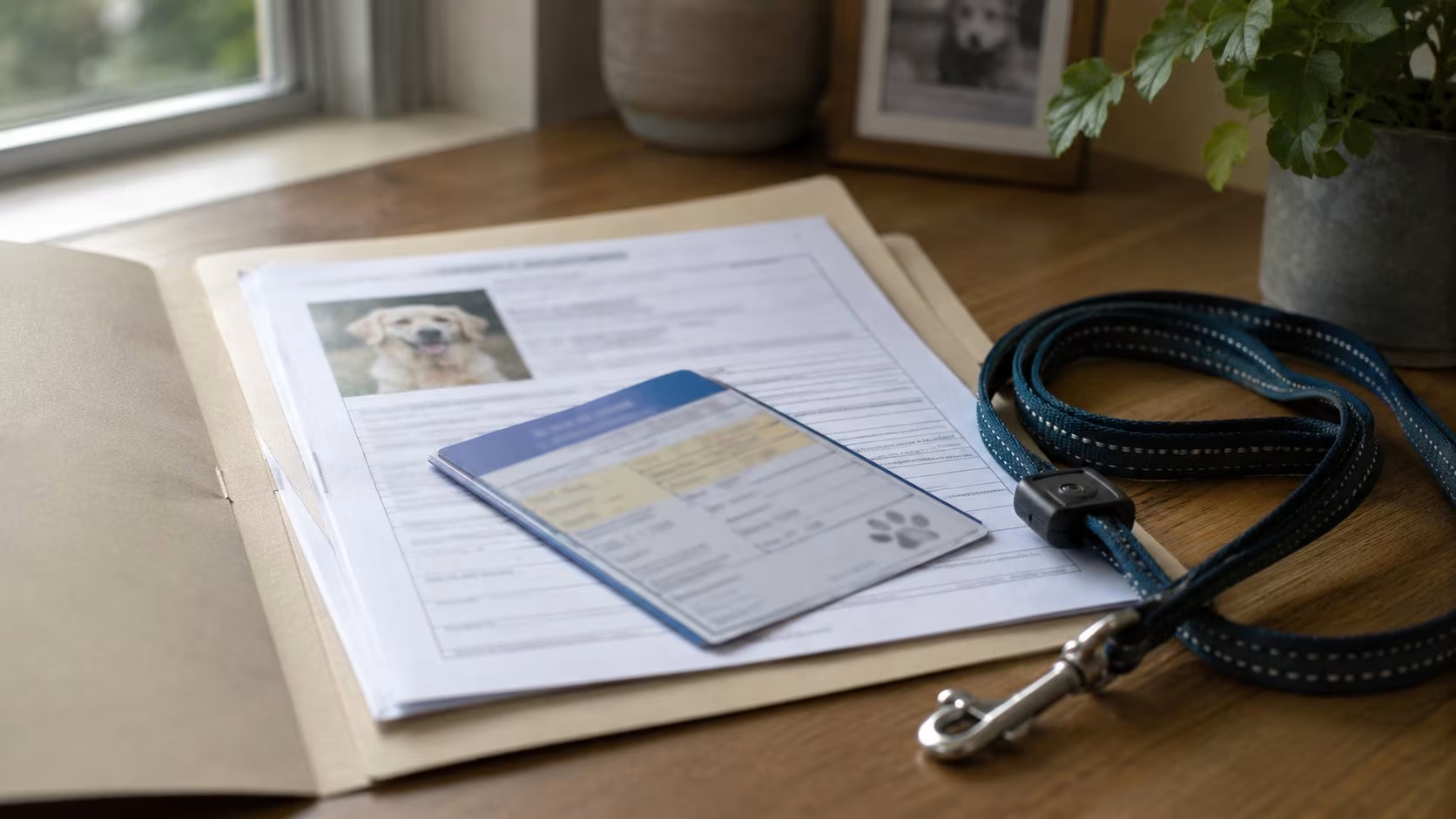
Writing a calm accommodation request
Use calm, factual language. State that you are requesting a reasonable accommodation related to a disability. Identify the dog by name, species, and basic description. Attach the professional letter if the disability-related need is not obvious. Say you are prepared to follow reasonable rules on sanitation, control, vaccination, and emergency access. Ask for a written response.
Do not overclaim. Avoid saying the dog is "certified by federal law," "registered with the ADA," or "allowed everywhere." Those phrases are false or misleading. Also avoid sending long medical histories unless your advisor tells you to. The housing provider usually needs enough reliable information to evaluate the request, not your complete clinical file.
If the answer is no, ask why in writing. A denial may be based on missing documentation, pet-policy confusion, a claimed direct threat, property-damage history, or a legal interpretation. Each reason calls for a different response. This is the point where local legal help can prevent a solvable paperwork issue from turning into a lease crisis.
State and city rules can add another layer, especially for housing, licensing, vaccination, and misrepresentation penalties. Check the agency or legal-aid source for your own location before copying a template from another state. A form that works in one jurisdiction may be incomplete or badly worded in another.
- Put the request in writing before the lease is signed if you can, and send it by email rather than raising it in a hallway conversation, so there is a timestamp.
- State one sentence: you are requesting a reasonable accommodation to the pet policy because of a disability-related need. Do not attach a diagnosis.
- Identify the dog by name, breed or type, weight and age, and say it is house-trained.
- Attach the professional letter only if the need is not obvious, and attach the vaccination record, local license and microchip number in the same message.
- Offer in writing to follow reasonable rules on leashing, common areas, waste, noise and access for maintenance.
- Ask for a written decision and a date. If something is missing, ask which document would complete the request.
- If the answer is no, ask for the reason in writing. A denial for missing documentation is fixable in a day. A denial claiming direct threat or property damage is a different problem, and that is the point to call a state fair-housing agency or legal aid.
- Keep every email in one folder. If the case ever moves to a state agency, the timeline of who asked for what and when is the evidence.
Household manners that protect the request
An emotional support dog does not need task training to provide comfort, but it does need household manners. Barking for hours, lunging in shared hallways, growling at maintenance staff, or soiling common areas can weaken the request and damage the owner's credibility.
The owner should have a backup plan for illness, hospitalization, travel, and financial emergencies. A support dog who misses meals, vaccines, or walks because the owner has a bad week is not being protected. The care plan should include a trusted backup person, monthly costs, emergency funds, and a safe place for the dog if the owner cannot provide care temporarily.
A documented file beats a purchased certificate because the certificate answers a question nobody with authority is asking. A housing provider wants to know who assessed the need, when, and under what license. An airline wants to know whether the dog is a trained service dog under the Air Carrier Access Act, and if it is not, whether it fits in a carrier under the seat at the pet fare. A restaurant manager wants to know whether the dog is trained to perform a task. No online registry answers any of those three questions, which is why the certificate gets waved away at exactly the moment it was bought for.





0 Comments
No comments yet. Be the first to share your thoughts!
Leave a Comment