

An emotional support animal is an animal whose presence eases a disability-related limitation. No task training is required, and that is exactly what separates it from a service dog. The label carries no ADA public access right, airlines have treated ESAs as pets since 2021, and after HUD's May 2026 enforcement memo a housing claim now rests mainly on state and local law.
An emotional support animal is an animal that helps a person with a disability by providing emotional stability, routine, comfort, or a calming presence. The support can be real and life-changing, but it is not the same thing as service-animal work. That distinction matters because rights change from one setting to another. A dog who helps a person sleep at home may be part of a housing accommodation request, while the same dog may still be treated as a pet in a restaurant or on an airline.
The simple definition is this: an ESA supports a person's mental or emotional health through the animal's presence and relationship with that person. It does not need to be trained to perform a specific disability-related task. That is the main difference between an ESA and a service dog.
Service dogs versus comfort-only animals
The ADA service animal FAQ draws a firm line between trained service animals and comfort-only animals. Under the ADA, a service animal is a dog trained to do disability-related work or tasks. A psychiatric service dog may interrupt self-harm, guide a disoriented handler, wake a person from a nightmare, or create space during a medical episode. An emotional support dog who comforts by being present is different.
A therapy animal is different again. Therapy animals usually visit hospitals, schools, libraries, or care facilities to support other people through organized programs. They may be screened and handled carefully, but they are not automatically service animals for one disabled handler. A pet can also provide comfort without being part of any disability accommodation request.

The labels are worth getting right, because calling an ESA a service dog invites a challenge you cannot win. Staff at a public accommodation are allowed to ask two questions: is the dog required because of a disability, and what task has it been trained to perform. There is no honest answer to the second question for an ESA, and some states penalize misrepresentation. If you are unsure what to expect from your animal in the first place, we go through that in what emotional support animals are expected to do.
An ESA may help by reducing loneliness, supporting a daily routine, encouraging sleep structure, giving tactile grounding during panic symptoms, or helping a person get out of bed and care for another living being. The animal's effect is usually relational, not task-trained. A cat that settles on a person's chest during nighttime anxiety may be meaningful support. A quiet dog who prompts a morning walk may help with routine and isolation.
The animal does not have to be a dog. Cats, rabbits and birds are all kept as emotional support animals, and the practical limits come from the building rather than from any federal species list. A landlord can still refuse an animal that is illegal to keep locally, that cannot be housed safely in the unit, or that poses a direct threat, and reptiles and exotics run into local ordinances far more often than cats do. Species rankings are worth less than an honest look at the animal in front of you, though our comparison of the best emotional support animals is a reasonable starting point on care demands.
| Task trained | Stores and restaurants | Cabin on a US flight | Housing | |
|---|---|---|---|---|
| Service dog | Yes, for a specific disability-related task | Admitted under the ADA | Accepted with the DOT Service Animal Air Transportation Form | Presumed exempt from pet rules and pet fees |
| Emotional support animal | No | No ADA right; the business decides | Treated as a pet since 2021 | Depends on state and local law after the May 2026 HUD memo |
| Therapy animal | Screened and handled, works with a program | Only where the program is invited | Treated as a pet | Treated as a pet in the handler's own home |
| Pet | No | Where posted rules allow | Pet fare, roughly $95 to $150 each way | Subject to pet rules, deposits and fees |
Federal guidance withdrawn on housing claims
Most ESA disputes happen in housing. A person may request an animal-related accommodation when the animal is connected to a disability-related need. The request may involve a no-pets building, breed rule, pet rent, pet deposit, number limit, or species rule. The outcome can depend on federal law, state law, local law, the type of housing, documentation quality, animal behavior, and current enforcement policy.
Old articles often treated ESA housing rules as simple and settled. That is risky now. The Federal Register notice on withdrawal of HUD fair-housing guidance documents says prior FHEO animal-accommodation guidance documents were withdrawn and should not be relied on as authoritative. That does not erase every possible housing claim, but it does mean broad blanket claims are poor advice.
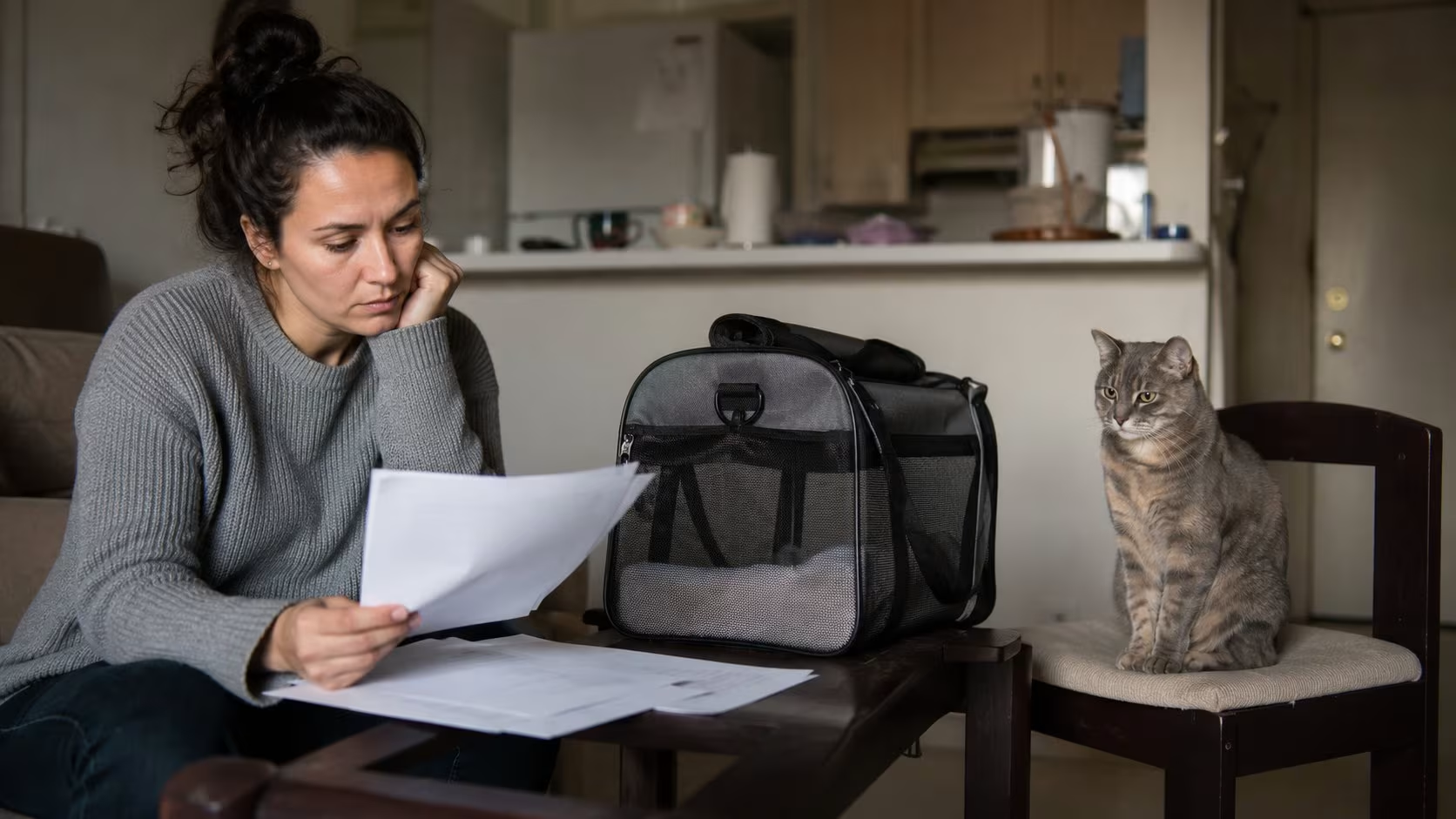
Since the federal route narrowed, the state agency is the one that matters. Your state or city fair housing office, not HUD, is now the realistic forum for an ESA complaint, and legal aid offices in most states screen these cases for free. State rules on the letter itself vary just as much: California's AB 468 has required a 30-day client relationship before a clinician issues one since 2022, while other states set no waiting period at all. Our walkthrough of how to get an emotional support animal in New York shows how much of the process is set locally.
The sequence matters, because a lot of ESA advice online still describes the world before it. HUD withdrew its 2013 and 2020 assistance animal guidance on September 17, 2025. On May 22, 2026 HUD's Office of Fair Housing and Equal Opportunity issued an enforcement memo, effective immediately, telling staff to stop pursuing complaints where the animal is an untrained emotional support animal, to treat only individually trained service animals as presumptively exempt from pet policies and pet fees, and to put open ESA cases on hold for individual review. HUD noted that ESAs featured in more than 20 percent of its fair housing complaints.
Two things the memo does not do. It does not repeal state or local fair housing law, which still protects assistance animals in many states and is now the practical place to bring a complaint. It also does not change who was covered in the first place: the Fair Housing Act generally does not reach owner-occupied buildings with four or fewer units, or a single-family home the owner rents out without an agent. If you live in either, the memo changed nothing for you, because the federal claim was never available.
Spotting a fake registry or ID card
An ESA letter should come from a licensed professional who has enough knowledge of the person's condition and support needs. The strongest letters are plain, specific, and limited to the setting. They connect the person, a disability-related limitation, and the support animal. They do not need to expose full therapy notes or deeply private medical details.
Weak documents often promise too much. Be wary of websites selling instant registration, national certificates, ID cards, vests, or guaranteed access everywhere. There is no federal ESA registry that turns a pet into an assistance animal for every setting. A purchased card may look official, but it usually does less than a clear letter from a legitimate treating professional.
Asking for two animals is a different request, not a bigger version of the same one. A letter that says a person benefits from animals in general is weak; one that explains what each animal does, and why one cannot cover both roles, is what survives review. The unit has to work too, since a landlord can weigh whether two animals fit the space. We take that apart in whether two emotional support animals are allowed.
The most common mistake is treating one ESA letter as a pass for every place. A housing request, airline pet policy, workplace accommodation, campus housing process, and hotel stay can all be handled differently. A letter that helps explain a housing need may have no effect at a grocery store or airline counter.
Another mistake is relying on gear. A vest, patch, badge, or laminated card may make an animal look official, but it does not create rights by itself. Some landlords and businesses have seen enough fake documents that flashy gear can make the conversation harder. Plain, accurate paperwork and calm animal behavior are more useful.
Owners also get into trouble by hiding problems. If the animal barks all day, bites, damages doors, urinates in hallways, or panics when left alone, the label will not solve the practical issue. The better path is to address behavior early and keep records showing responsible care, veterinary attention, and reasonable management.
- Check who signed it. A valid letter comes from a licensed mental health professional who is treating you, on their letterhead, with license type, number and issuing state. A company name where the clinician's name should be is the end of the inquiry.
- Check whether anyone assessed you. If the entire process was a web form and a card payment, no clinical relationship exists. California requires a 30-day client relationship before a letter is issued, with limited exceptions.
- Look for what it does not claim. A legitimate letter is about a housing accommodation. It does not promise airline access, store access or nationwide rights, because it cannot deliver them.
- Ignore the add-ons. Registry numbers, certificates, ID cards, vests and patches have no legal effect anywhere in the United States, and there is no federal ESA registry for any of them to be issued from.
- Confirm the license yourself. State licensing boards publish license lookups, and a landlord may run the same check. A number that does not resolve makes the whole request look manufactured.
Store rules on barking and lunging
An ESA label usually does not give access to restaurants, grocery stores, theaters, hospitals, shops, or other ADA public accommodations. Businesses may choose to be pet-friendly, but that is not the same as a federal service-animal right. Some outdoor patios, hardware stores, bookstores, or local businesses welcome dogs; others do not. The ESA label usually does not override posted pet rules.
Public behavior still matters even where the animal is welcome. Barking, lunging, house-soiling, blocking aisles, climbing on furniture, or bothering strangers can end permission quickly. A support animal should be under control, healthy, clean, and safe around people and other animals.
Airline pet fees after the rule change
Airline rules changed. The U.S. Department of Transportation's service animal guidance says service animals under current air-travel rules are dogs individually trained to do work or tasks for qualified people with disabilities. Emotional support animals are not treated as service animals under that rule.
In practice that means booking a pet fare. American, Delta, United, Southwest, JetBlue and Alaska all stopped accepting emotional support animals in early 2021, and on those airlines an ESA now flies in cabin under the seat, for a fee that generally runs $95 to $150 each way, or not at all if it is too large. Cabin spots are capped per flight and sell out on popular routes, so the booking call comes before the ticket purchase. Some Latin American and European carriers still accept ESAs under their own policies, which we cover in flying with an ESA after the rule change.

An ESA should be able to live safely in the setting being requested. The animal should receive veterinary care, parasite prevention, food, water, grooming, enrichment, and a stable routine. If the animal is anxious, aggressive, destructive, or constantly noisy, the support plan may harm the animal and the household.
The owner also needs a backup plan. Who can care for the animal during hospitalization, travel, eviction risk, job loss, or a mental health crisis? Can the owner afford routine and emergency care? Can the animal be separated from the owner when repairs, inspections, or emergencies happen? These practical details do not make the support less real. They make it sustainable.
Setting-based limits on ESA status
What an ESA is has not changed since 2020. What has changed is what the label gets you. Air travel closed in 2021, ADA public access was never open, and federal housing enforcement narrowed sharply in May 2026. The remaining ground is real but local: state and city fair housing law, a landlord who is willing, and a letter from a clinician who actually treats you.




0 Comments
No comments yet. Be the first to share your thoughts!
Leave a Comment